Last 6 Months Learning the Road to Coding
My Last 6 Months in Consulting: Key Projects, Hard Lessons, and Wins That Moved the Needle
The last six months have felt like a Binary Big Bang—a generation-defining transition where foundation models have finally cracked the language barrier between people and technology. For those of us operating as GTM architects, this hasn’t just been a season of “new tools.” It has been a fundamental shift from a world of rules-based, deterministic software to one of autonomous, probabilistic systems. We are witnessing a “Declaration of Autonomy” where the Turing Test—once the loftiest benchmark for machine intelligence—is effectively broken every day by LLM-backed agents.
I am sharing these reflections now because of a startling, dangerous disconnect I see in the boardroom. While 92% of companies are racing to invest in AI, a mere 28% are investing in the upskilling required to use it responsibly. We are attempting to pilot the most powerful engine in history without teaching anyone how to steer. In my practice, I describe this as moving from “complicated” systems to “complex” ones. The complicated systems of the past were like a Ferrari—highly predictable, precision-crafted machines. If a Ferrari breaks, a mechanic knows exactly which bolt is loose. But our new AI-driven ecosystems are like a rainforest. In a rainforest, flora and fauna interact in ways we cannot always predict. You don’t “fix” a rainforest; you act as its steward. Over the last half-year, my mission has been helping enterprise clients survive this “rainforest” through compressed transformations.
1. The PRM Pivot: Solving the “Crisis of Coordination”
In my recent work with a healthcare-adjacent enterprise, I encountered what I call the Crisis of Coordination. Data sat in isolated EHR (Electronic Health Record) silos, creating a fragmented landscape where the patient was forced to act as their own care coordinator. The human cost of this is staggering. In the ICU, “adult orphans”—patients who are “unrepresented” or “unbefriended” without authorized surrogates—account for 16% of all patients. Without a unified 360-degree view, these individuals face physical danger because providers delay decisions due to liability or, conversely, risk overtreating them.
Methodology: From Record to Relationship Depth
We executed a “PRM Pivot,” shifting the client from a “System of Record” to a “System of Engagement” using Salesforce Health Cloud. The goal was to build Relationship Depth, moving from clinical transaction tracking to a holistic “one-to-moment” personalization.
We integrated clinical data with non-clinical “social determinants” of health. Our secret weapon was the implementation of the HEEADSSS psychosocial assessment (Home, Education/employment, Eating, Activities, Drugs, Sexuality, Suicide/depression, Safety). By embedding this assessment into the nursing workflow, we allowed the system to ask developmentally suitable questions that captured the patient’s entire support network. This transformed the data from a static list of lab results into a “Caregiver Map.”
| Feature | System of Record (Legacy EHR) | System of Engagement (PRM/Health Cloud) |
| Primary Philosophy | Clinical transactions and billing documentation. | Patient-centered relationships and journey management. |
| Data Architecture | Siloed medical history; proprietary formats. | Unified 360-view (Clinical + Social + Behavioral). |
| Operational Stance | Reactive: Wait for the next visit or crisis. | Proactive: Automated check-ins and risk stratification. |
| Key Insight Tool | Simple patient portal (e.g., MyChart). | Caregiver Map (Full visibility into support networks). |
Outcome & Evidence
- 15% reduction in readmission (churn) rates by identifying high-risk patients through automated post-discharge follow-ups.
- 40% faster access to unified data for support teams, directly addressing the “adult orphan” visibility gap.
- 35% reduction in “no-show” rates through omnichannel reminder systems that meet patients where they are (SMS, email, and portal).
2. The 1P Data Renaissance: Winning in a Cookie-less Void
The regulatory uncertainty in the EU and emerging markets like Turkey has turned the “vanishing cookie” from a technical hurdle into a GTM crisis. As third-party signals disappear, I’ve had to guide clients through a First-Party (1P) Data Renaissance. We’ve moved away from “vanilla” paid media to prioritize Owned Media—newsletters, blogs, and podcasts—which remain the most effective yet most underfunded assets in the modern stack.
Approach: The Hack-Pack-Stack Framework
To build these capabilities without blowing the budget, we utilized the “Hack-Pack-Stack” methodology to productize marketing:
- Hack: We built a standalone version of a concept (e.g., a contextual ad campaign) to test technical feasibility and customer traction.
- Pack: Once we saw a signal, we cleaned up the process, removing “data bloat” and content waste.
- Stack: Finally, we refactored the solution into a zero-maintenance, automated version integrated into the permanent digital core.
We also treated Vertical Video (Reels and Shorts) as an algorithmic discovery engine. For B2B clients, this meant a hard pivot to LinkedIn’s “First Impression Ads” and CTV integrations, moving away from static whitepapers to frictionless, mobile-first storytelling.
Outcome
By utilizing contextual advertising platforms like WeatherAds, which use real-time signals (location, time, weather) rather than cookies, we helped a client deliver hyper-relevant ads that doubled conversion rates compared to their legacy third-party benchmarks.
3. Technical Debt Remediation: Cleaning Up the “Frankenstack”
I stood in a boardroom recently where the CEO demanded “AI everywhere,” while his team was struggling with a $1.52 trillion problem: the “Invisible Problem” of clunky, old software. We are facing a Catch-22: GenAI implementation actually causes technical debt to rise if the digital core is not modernized first. To address this, we applied the “Accenture approach” to modernization.
Approach: Evergreen IT and FinOps by Design
I worked with an enterprise client to remediate their “Frankenstack”—a patchwork of on-premises systems that acted as an anchor. We didn’t just move to the cloud; we implemented “Evergreen IT,” an approach focusing on continuous updates to keep systems current. We monitored “Technical Debt Density” (the units of cost per line of code) to prioritize which applications were draining the most “interest” from the business.
Following the model of CTT (Correios de Portugal), who worked with Avanade to build their digital core, we focused on a “Single Pane of Glass” view. By utilizing FinOps frameworks, we aligned tech spend directly with business value, ensuring every cloud workload was rightsized for efficiency.
Outcome
- 15% reduction in initial migration costs through workload optimization (matching the CTT benchmark).
- The transition from a “labor arbitrage” model to a “tech arbitrage” model, where efficiency is unlocked through platformization rather than just offshoring headcount.
4. Integrated Marketing Maturity: The LEGO/36-Hour Standard
One of my most challenging projects involved a siloed marketing function where internal “Tiger Teams” were essentially competing for budget and “glory” rather than customer outcomes. I applied the ADEPT Integrated Marketing Methodology to move the client from “Limited Planning” to “Agile Planning.”
Approach: The RACE Framework and Internal CRM Hubs
We used the RACE Framework (Reach, Act, Convert, Engage) to restructure their workflows. A critical win was modeled after LEGO, which established an internal CRM hub to become entirely self-sufficient. In the past, this client’s campaigns would take weeks of cross-departmental “firefighting.” By building Holistic Workflows that integrated legal and regulatory approvals directly into the production timeline, we dismantled the silos.
| Planning Level | Characteristics | Operational Focus |
| Limited Planning | Ad-hoc website tests; basic email blasts. | Reactive “firefighting” and silos. |
| Competitive Planning | Simple personalization; regular customer feedback. | Targeted but disjointed campaigns. |
| Agile Planning | AI-optimized contact strategy; full lifecycle automation. | Integrated “Tiger Teams”; 36-hour launch capability. |
Outcome
By centralizing their capabilities, the client moved to a “Strategic Campaign” model where 70% of performers rated their flow as “excellent.” We successfully reduced their launch cycle from months to just 36 hours, allowing them to respond to market shifts in real-time.
Hard Lessons from the Trenches: Consulting Scars
Reflecting on these projects, I’ve distilled four hard-won principles:
- Beware the Optimism-Execution Gap: This is the treacherous chasm between the boardroom excitement of “AI will change everything” and the reality of a pilot project that has been “in testing” for six months. Most teams discover that security and privacy concerns make implementation feel like defusing a bomb blindfolded.
- The Ship of Theseus Approach: Never attempt a total “Rip-and-Replace” of a Frankenstack. You replace the planks one by one while the ship is still sailing. Eventually, you have a modern vessel, but the business never stopped moving.
- Durable Skills Over Technical Spikes: AI is the engine, but human judgment remains at the steering wheel. We need “strategic architects” who can orchestrate systems, not just prompt engineers.
- Trust as the New Differentiator: We can only let systems be as autonomous as we trust them. Look at the Delta social media crisis of July 2024, where a single employee’s response to a political post sparked a global backlash. A single autonomous agent making a similar error can destroy a brand overnight. Trust is now an enterprise risk.
Current Thinking: GTM in the Era of Agentic Workflows
As we look toward 2026, the shift is moving from “Technology as a Tool” to “Technology as an Orchestrator.”
- Agentforce & Autonomous Agents: Salesforce’s hard pivot to Agentforce is a signal to us all. These agents don’t just chat; they leverage existing Apex code and flows to make plans and take autonomous actions.
- The Model Context Protocol (MCP): The emergence of the MCP standard (created by Anthropic and embraced by Google/Microsoft) is a game-changer. It allows agents to communicate across different software tools and external data sources using a standardized language.
- Generative UI: We are moving toward interfaces that aren’t just static layouts, but structures that change their flow and interaction methods in real-time based on an individual’s context.
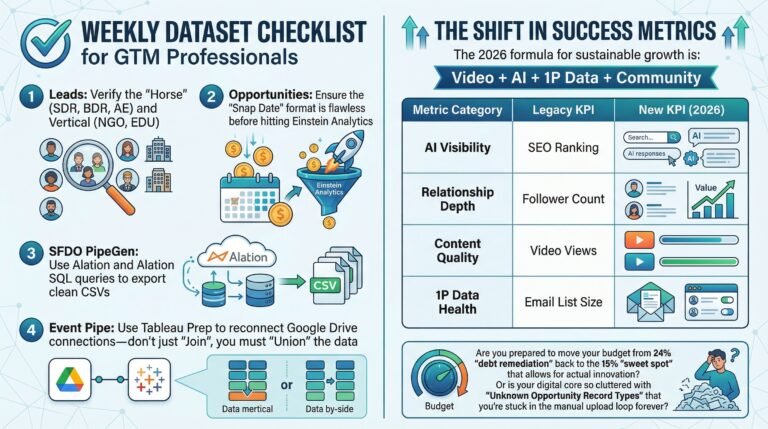
- CFO Language (MMM): Marketing Mix Modeling and lift tests are no longer optional. To get any project approved today, you must speak in terms of P&L and ROI.
Conclusion: Your Turn to Move the Needle
In the 1990s, we had “internet departments.” By 2005, the internet was just “how business gets done.” AI is on that exact trajectory; it is becoming the invisible infrastructure of the global economy. The Binary Big Bang is a brief moment of transition. It is the time to decide if you will be a steward of a complex rainforest or a victim of a broken Ferrari.
I leave you with two questions to bring to your next leadership meeting: Which part of your digital core is currently paying the highest “interest” on technical debt? And what “Singles & Doubles” are you hitting this quarter to close your own Optimism-Execution Gap?
The frontier is open, but it rewards the architects, not the spectators.