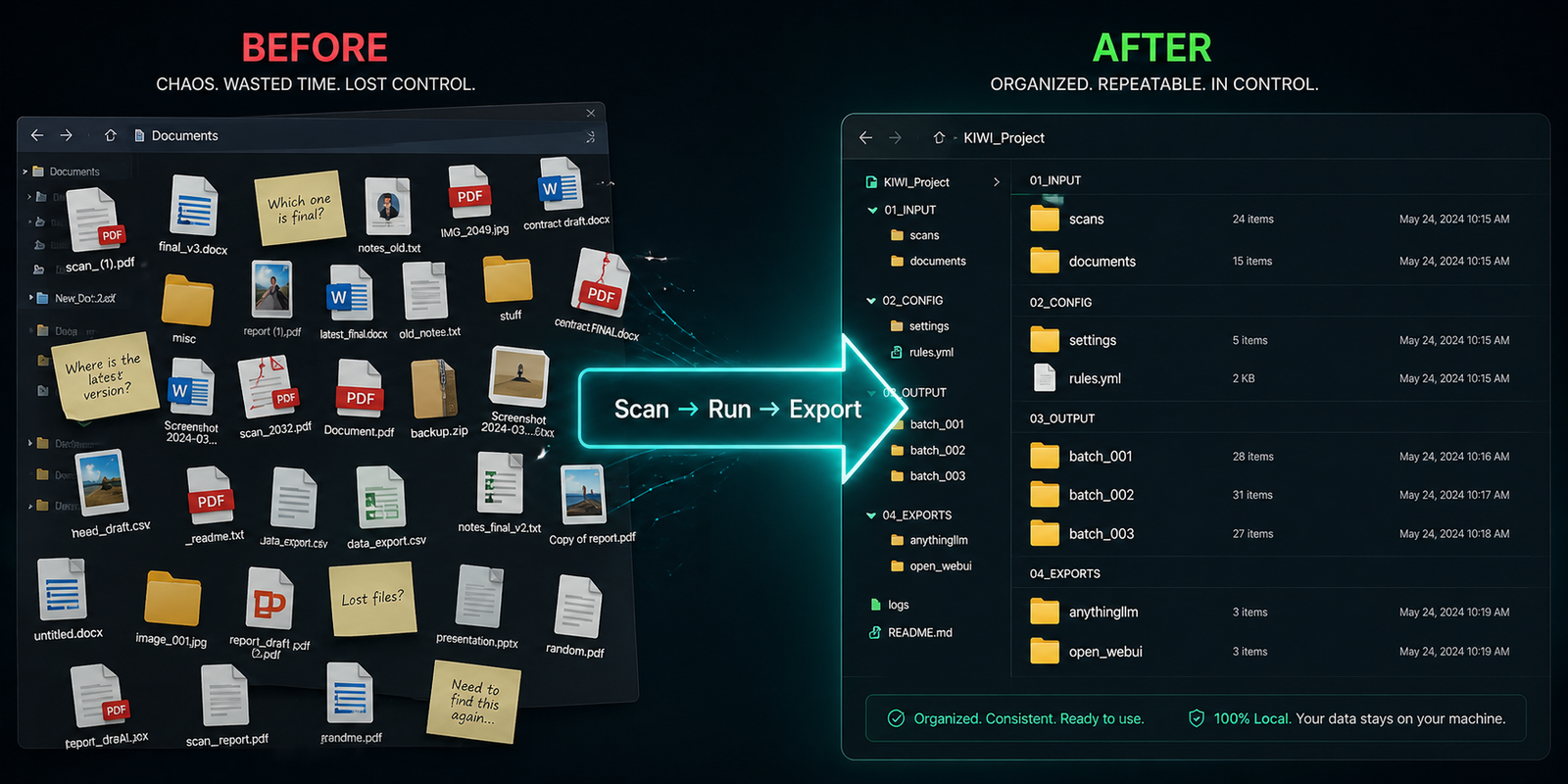
The Real Problem with AI Isn’t Models—It’s Input
The Real Problem with AI Isn’t Models—It’s Input
If you’ve spent time with tools like Open WebUI or AnythingLLM, you’ve probably noticed something: they’re powerful—but getting your content into them in a usable way is still surprisingly manual.
Messy folders. Random file names. No structure. No consistency.
And none of that plays well with AI.
The Insight
The problem isn’t the models.
It’s the layer before the model.
AI works best with structured, organized, consistent input—but most real-world data isn’t like that at all. In practice, that means the biggest friction point isn’t using AI tools—it’s preparing data for them.
What I Built
So I built a small tool to solve this for myself.
- Scans batches of files
- Classifies and organizes them
- Outputs structured folders ready for AI ingestion
- Processes multiple batches under a single project
The Real Challenge
The interesting part wasn’t the logic—it was the experience. Making the workflow intuitive for non-technical users required multiple iterations.
What Finally Worked
Set up once → scan batch → run → repeat
Coding with AI
Using tools like Cursor, ChatGPT, and Claude accelerated development, but it also highlighted that AI doesn’t replace thinking through workflows—it enhances it.
Why This Matters
The real value in AI workflows comes from structuring inputs and building repeatable systems—not just using models.
Closing Thoughts
KIWI is still evolving, but it’s getting close. If you’re working with local AI tools and facing similar challenges, I’d be interested to hear how you’re approaching it.