From Data Fragmentation to Strategic Visibility: Operationalizing the DemandGen Growth Engine
GTM Strategy · B2B Marketing
In high-velocity Go-To-Market (GTM) organizations, unified demand generation reporting is no longer a luxury—it is the essential infrastructure of a modern “Digital Core.” This report serves as a post-implementation review of a strategic initiative that moved our organization from manual, siloed data updates to a high-performance, multi-source analytical framework.
The Architecture of Fragmentation
By leveraging an API-first approach and refactoring our data ingestion layers, we have transformed fragmented signals into a unified Growth Engine that now provides visibility into over $76.1M in pipeline for major activations. However, reaching this state of maturity required a rigorous root cause analysis of the technical debt that previously suppressed our GTM velocity.
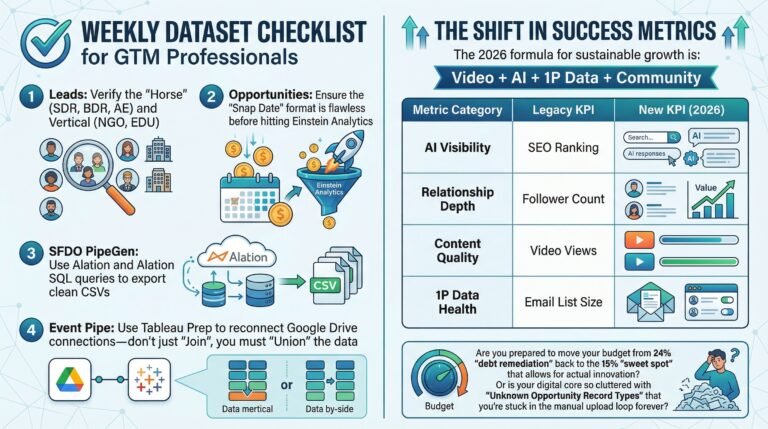
Technical debt is the primary inhibitor of GTM accuracy and organizational velocity. Within our environment, data silos acted as a tax on innovation, requiring manual dependencies that throttled data accessibility and created significant friction in weekly reporting cycles.
💡 Pro Tip
Target the “sweet spot” of 15% IT budget allocation for technical debt remediation. This strategic balance allows you to pay down liabilities without sacrificing innovation, directly yielding incremental revenue and increased operational maturity.
Engineering the Integrated DemandGen Engine
The solution was engineered using a “Digital Core” methodology, prioritizing an API-first approach to ensure interoperability between legacy sources and modern visualization layers. We orchestrated a four-tier technical engine powered by Salesforce & Einstein Analytics as the master repository, Tableau Prep for ETL orchestration, Alation for deep-database extraction, and Business Objects as the legacy source—creating seven core datasets that drive the entire Growth Engine.
“Leadership now operates from a ‘Single Pane of Glass’ providing visibility into over $76.1M in ‘Pipe in Room’ for major activations.”
Measurable Outcomes and Strategic Transformation
The DemandGen Engine has produced significant pipeline results across major initiatives. Virtual HES Main Registration generated $76.1M Pipe in Room with $4.96M Closed Won, while DF20 Dreamforce delivered $80.7M PIR with $7.57M Closed Won. Beyond revenue impact, we achieved a 16% reduction in technical debt density per application and an 84% increase in successful builds through automated development processes. The transition from legacy metrics to our New Engine KPIs represents a forward-looking roadmap focused on AI citations over SEO rankings, incremental revenue lift over raw conversions, and LTV retention over follower counts.
Key Takeaways
- Unified demand generation reporting is the essential infrastructure of modern GTM organizations, not a luxury
- Technical debt acts as a tax on innovation—allocate 15% of IT budget to remediation for optimal balance
- API-first architecture with a “Digital Core” methodology transforms fragmented data into actionable insights
- Focus on forward-looking KPIs: AI citations over SEO, incremental revenue lift over raw conversions, LTV over vanity metrics
GTMStack.pro
Want more GTM strategy like this?
Explore the GTMStack framework — built for B2B marketers who want pipeline, not just pageviews.